· Graham G. Hughes
Mediawork vs farmerswife: which is right for your media business?
Mediawork and farmerswife both help media vendors manage projects, resources and finances—but their strengths differ. Mediawork connects the entire journey from enquiry and quoting to scheduling, delivery and invoicing, while farmerswife excels at complex resource, equipment and workforce management. Here’s how to decide which fits your business.
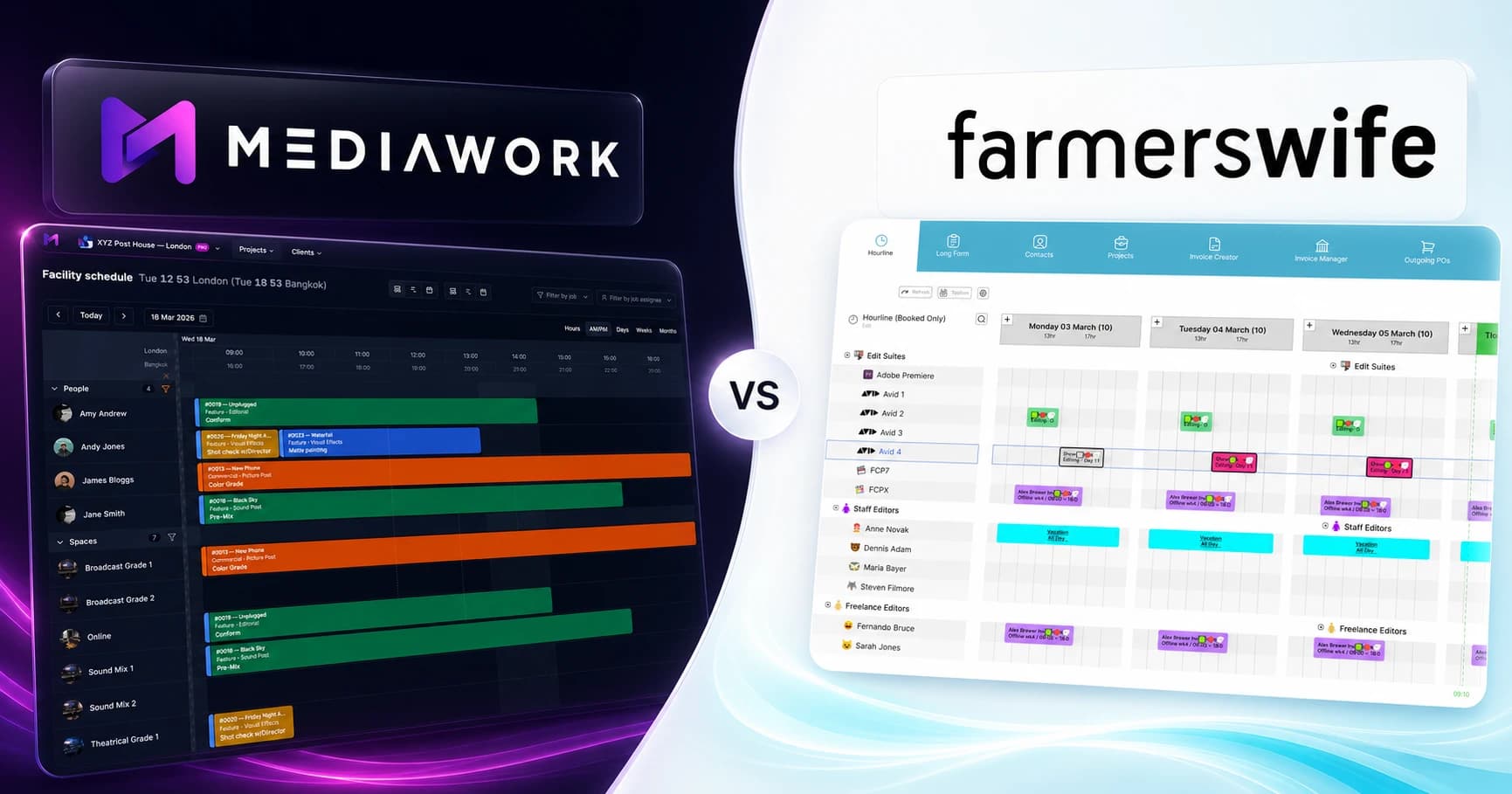
Mediawork and farmerswife both help media vendors schedule resources, manage projects, track costs and issue invoices.
But they approach the job from different directions.
farmerswife’s centre of gravity is operational control: complex scheduling, equipment, personnel and financial reporting.
Mediawork connects operations to the commercial side of the business: enquiries, sales pipeline, quotes, project delivery, client communication and invoicing.
That distinction matters more than the length of either feature list.
The short answer
Choose Mediawork if you want:
- Sales CRM, quoting and operational delivery in one system.
- One connected workflow from first enquiry and quote to project delivery and final invoice.
- Quote templates, client rate cards, margin calculations and version history.
- New clients to discover your company through a vendor directory.
- Conflict detection and reusable scheduling templates.
- Tasks, project conversations and client communication built in.
- A browser-based platform shared by Sales, Operations and Finance.
Choose farmerswife if you need:
- Deep resource scheduling and utilization reporting.
- Detailed equipment dispatch and inventory management.
- Advanced overtime, leave and labour rules.
- Extensive purchasing and financial controls.
- Highly configurable reporting and integrations.
- Cloud, private or on-premises deployment options.
Mediawork starts with winning the job
Before a project can be scheduled, it has to be won.
Mediawork includes a sales CRM designed around media work. Vendors can manage accounts, contacts, titles and jobs while moving opportunities from enquiry through quoting, delivery and invoicing.
Pipeline dashboards show total and weighted opportunity values, giving sales and management a view of the work that may be coming—not only what has already reached the schedule.
When it is time to quote, Mediawork provides:
- Reusable quote templates.
- Per-client rate cards.
- Live margin calculations.
- Multi-currency pricing and taxes.
- Quote revisions and version history.
- Branded PDF quotes.
- Integrated NDA handling.
- Supporting documents and project conversations.
Vendors can also publish a profile in the Mediawork directory, showing their services, facilities, talent and credits. Prospective clients can find the profile and send an enquiry directly to the vendor.
farmerswife has a substantial contact database and powerful quoting capabilities, particularly with its optional Budgeting module. What it does not appear to offer is the same native sales pipeline, weighted opportunity forecasting or vendor-discovery channel.
If managing and winning opportunities is as important as delivering them, Mediawork has the stronger starting point.
Both can run the job—but with different scheduling strengths
Once work is awarded, Mediawork carries it into operations without recreating its commercial data.
Teams can schedule people, suites, rooms and equipment across timeline, Gantt and calendar views. Mediawork detects resource conflicts before bookings are made and provides reusable scheduling templates for recurring types of work.
Templates can define:
- The steps involved in the work.
- The expected duration of each step.
- Dependencies between steps.
- The roles, people, spaces or equipment capable of completing them.
If an upstream step moves, its dependent steps can move with it. This makes templates useful for repeatable workflows such as localization, mastering, editorial, quality control and media delivery.
Actual costs are then tracked against the quoted service lines, while relevant schedules and progress can be shared with the client.
farmerswife’s scheduling also provides conflict detection, reusable booking structures and detailed resource scheduling.
Its advantage is in the depth surrounding the schedule:
- Long-range utilization and capacity analysis.
- Granular booking controls and resource classes.
- Shift patterns and personnel events.
- Advanced labour and overtime rules.
- Specialist equipment dispatch.
- Detailed operational reporting.
The distinction is not that Mediawork offers basic scheduling while farmerswife offers advanced scheduling.
Mediawork connects capable scheduling to the complete enquiry-to-invoice workflow. farmerswife goes further when utilization, equipment and workforce complexity dominate the business.
Tasks and project communication
farmerswife does have task functionality. It includes scheduled Task Bookings, assignable To-dos and specialist Project To-dos.
Its fuller collaboration experience comes through Cirkus, a separate product that can synchronize projects, bookings, tasks and time reports with farmerswife.
Mediawork includes everyday task and communication tools inside the main platform:
- Task list, board and calendar views.
- Assignees, priorities, deadlines and reminders.
- Tasks linked to jobs and titles.
- Tasks created from project conversations.
- Comments, replies, mentions and attachments.
- Team and client project threads.
- Dedicated Sales, Operations and Finance inboxes.
- Email replies captured in the appropriate conversation.
The farmerswife-plus-Cirkus combination is capable, but it is a broader setup. Mediawork is simpler for vendors that want the commercial record, schedule, task list and conversation to remain with the same job.
Cost tracking and invoicing
Mediawork follows the financial path of the work:
- Quote and margin calculation.
- Actual costs against quoted service lines.
- Overtime and other adjustments.
- A consolidated view of unbilled work.
- Invoice creation and billing runs.
- Draft, sent, paid and overdue statuses.
- Xero-ready and generic CSV exports.
The emphasis is on ensuring that completed work becomes billable work without reconstructing it at the end of the month.
farmerswife provides more extensive financial control:
- Prepayment, part and final invoices.
- Credit notes and partial payments.
- Purchase orders and approval workflows.
- Incoming supplier invoices.
- Price agreements and advanced rate structures.
- Highly configurable financial reports.
- Separately licensed QuickBooks Online and Xero integrations.
Mediawork offers the more focused quote-to-cash workflow. farmerswife is stronger when a vendor needs deeper operational finance, purchasing and reporting controls.
Where farmerswife clearly goes further
Several requirements point strongly towards farmerswife:
- Barcode or QR-based equipment dispatch.
- Equipment kits, consumables and maintenance histories.
- Complex overtime and labour calculations.
- Detailed resource utilization reporting.
- Multiple operational or financial divisions.
- Physical and digital media-library management.
- Formal supplier purchasing and approval controls.
- Extensive custom financial reporting.
- On-premises infrastructure or bespoke enterprise integrations.
Mediawork should not be presented as matching these specialist capabilities today.
The question is whether a vendor genuinely needs that depth—or would be taking on a more complex system without using much of it.
Which should a vendor choose?
Mediawork is likely the better fit when:
- You want to manage an opportunity before it reaches the schedule.
- Sales, Operations and Finance should share one project record.
- Quoting speed, margin visibility and version control matter.
- Repeatable work needs reusable, dependency-aware schedule templates.
- You want new clients to discover and contact your company.
- Tasks and client communication should live with the job.
- You prefer a focused, browser-based application.
farmerswife is likely the better fit when:
- Scheduling complexity is the operational heart of the business.
- Capacity and resource utilization drive management decisions.
- Equipment requires detailed inventory and dispatch control.
- Labour rules and overtime calculations are complex.
- Purchasing and financial reporting require extensive configuration.
- Private or on-premises deployment is essential.
The verdict
farmerswife is the more powerful specialist operations system. For vendors with complicated facilities, equipment, labour and reporting requirements, that depth can be decisive.
Mediawork connects more of the vendor’s commercial journey. It helps a company attract enquiries, manage its pipeline, produce profitable quotes, schedule the work, coordinate delivery and turn completed work into invoices.
So the deciding question is not simply which platform has more features.
It is whether your biggest challenge is controlling operational complexity—or connecting the whole journey from winning the job to getting paid.